Medically reviewed by Dr. Massimo Gramanzini, OD
If you have been told by more than one office that contacts will not work for you, or you have been handed lens after lens that hurts, blurs, or pops out, you are asking a fair question: is there actually an option left for me, or do I just live with glasses that never quite focus right? For most patients with keratoconus, a corneal transplant, a cornea changed by old RK or LASIK surgery, severe dry eye, or high astigmatism, the answer is yes. You likely just need a lens fit by an office that works with irregular corneas every day, not once in a while.
A scleral lens is a larger, rigid lens that vaults completely over the cornea, the clear dome on the front of your eye, and rests instead on the sclera, the white part of the eye. Because it never touches the cornea itself, it never rubs against the exact surface that is irregular, scarred, or sensitive. Standard soft or small rigid lenses drape over that irregular surface and shift, warp, or fall out during the day. A scleral lens skips that problem by landing on a surface that is far more tolerant of a foreign object sitting on it, and it tends to stay centered and stable instead of shifting with a blink.
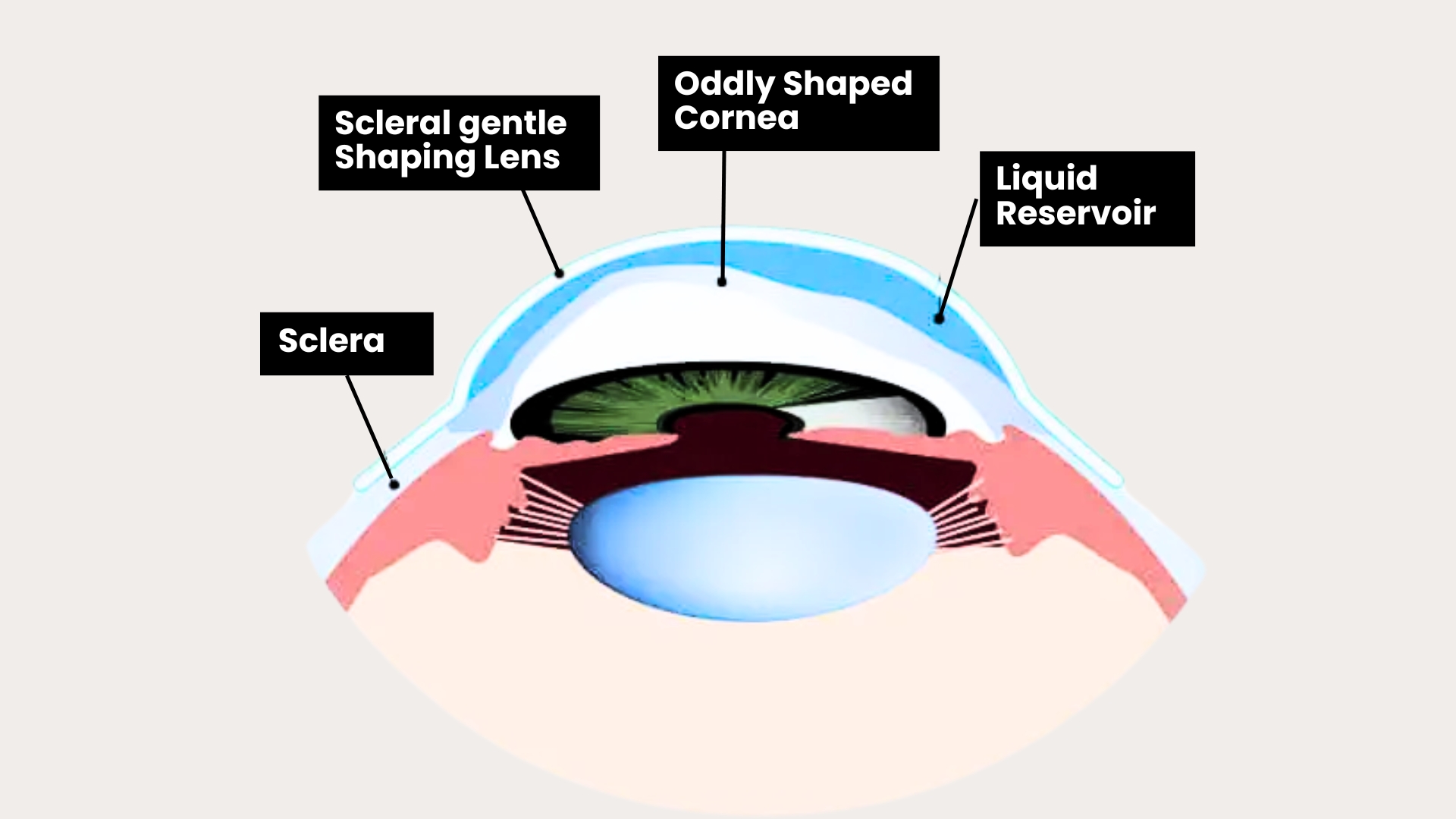
A scleral lens does two jobs at once, and both matter for different reasons.
Most patients assume a larger lens will feel like more foreign material in the eye and expect it to be worse. It usually is not. The cornea is one of the most nerve dense tissues in the body, which is why even a small piece of debris on it feels unbearable. The sclera has far fewer nerve endings. Since a scleral lens rests on the sclera and never touches the cornea, many patients report that it feels more comfortable, once fit correctly, than the small lenses they struggled with before.
The cornea is one of the most nerve dense tissues in the body. The sclera has far fewer nerve endings, which is why the bigger lens is usually the more comfortable one.
Keratoconus is a condition where the cornea gradually thins and bulges outward into a cone shape instead of staying evenly round. That cone distorts light as it enters the eye, which creates blur and streaking that glasses cannot fully correct because the surface itself is uneven. It typically begins in the teens or twenties and is one of the most common reasons patients end up needing a scleral lens instead of standard correction.
Fitting an irregular cornea well takes more than a standard trial lens set off a shelf. At Family Eye Center in Davie, Dr. Gramanzini uses tools built specifically for this kind of fitting, and the process is built around your eye rather than a general starting point.
You can read more about the process on our scleral lenses page, and if a full eye exam has not been done recently, that is usually the first step before any specialty fitting begins. You can learn more about that on our eye exam page.
A scleral fit is a series of visits, not one appointment where you walk out wearing a finished lens. Every eye is shaped differently, and the lens is refined step by step until the fit, comfort, and vision are right. Patients who arrive expecting a single visit are often the ones who get discouraged early, so we talk about this openly from the start. Patients who understand it as a process tend to stick with it and end up genuinely happy with the result.
Patients come from Davie, Plantation, Sunrise, Weston, and Cooper City specifically for specialty lens fittings. The most common story we hear is almost always the same: another office told them they were hard to fit, or handed them a lens that never worked, and they gave up looking for a solution. If that sounds familiar, a scleral lens fitting may be worth a conversation before you decide contacts simply are not for you.
If you have been struggling with irregular vision, a previous diagnosis of keratoconus, a corneal transplant, or dry eye that has not responded to drops, call Family Eye Center in Davie at (954) 423-8444 to schedule an evaluation. We will look at your specific eyes and tell you plainly what options exist for your situation.
Medically reviewed by Dr. Massimo Gramanzini, OD. Dr. Gramanzini has practiced in Davie for over 25 years and is certified in the treatment and management of ocular disease. Meet Dr. Gramanzini.