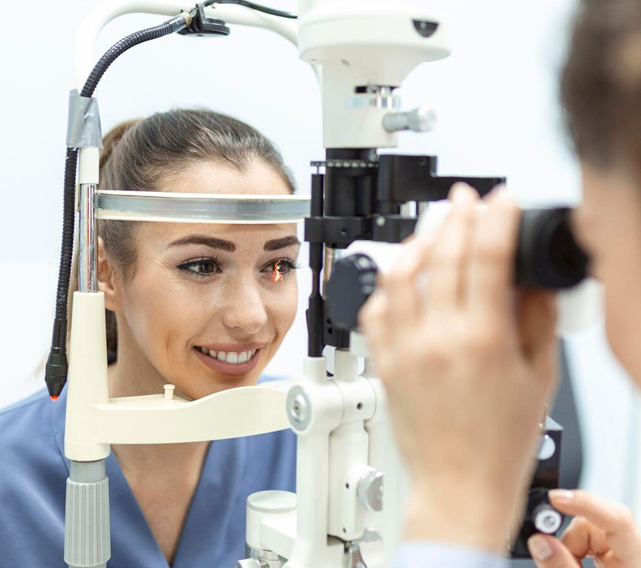
A comprehensive Eye Health Examination is a complete assessment of your vision and associated structures. This includes evaluating all the structures of the eye including the cornea, lens, vitreous, retina, lids, eyelashes and sclera. We also assess for diseases and conditions such as glaucoma, cataract, macular degeneration, and diabetic and hypertensive retinopathy, along with many other diseases that can be detected by evaluating your eye health. A vision assessment is also performed and if needed a prescription for glasses can be given. A Comprehensive Eye Exam is an essential part of preventative care to maintain the health of your eyes. In addition, further testing can be performed for those patients interested in a contact lens evaluation.
A thorough eye exam looks for far more than your prescription. It screens for conditions that cause no symptoms until they are advanced. These are the instruments we use and what each one is for: Two of the conditions we screen for here have their own pages if you want more detail: glaucoma detection and management and diabetes and the eye.
Our Optovue OCT takes a cross sectional scan of the retina and optic nerve, showing the layers beneath the surface. It detects changes from glaucoma, macular degeneration and diabetic eye disease earlier than they can be seen by looking at the eye alone.
We use a Humphrey visual field analyzer and a VF2000 virtual reality field system to map your peripheral vision. Peripheral loss is where glaucoma damage begins, and it happens so gradually that most people do not notice it themselves.
Our DRS fundus camera photographs the back of your eye, creating a permanent record we can compare year over year. Change over time is often the earliest sign that something needs attention.
We finish and edge lenses on site with a Santinelli LE-7070 edger. Having our own lab means many prescriptions are turned around faster, adjustments are handled in house, and the finished glasses are checked against your prescription here rather than at an outside facility.
How often depends on your age and risk. As a general guide, children should be examined in infancy, again between the ages of 3 and 5, and before first grade, then regularly through the school years. Adults with healthy eyes are usually seen every one to two years, and anyone aged 65 or older, or with diabetes, high blood pressure, a family history of eye disease, or who wears contact lenses, should be seen every year. We will recommend the right interval for you.
A comprehensive exam checks far more than whether you need glasses. It includes a review of your health history, a vision and prescription check, tests of how your eyes focus and work together, a measurement of the pressure inside your eye to screen for glaucoma, and a detailed look at the front and back of the eye. Because the eye is the one place a doctor can see your blood vessels and optic nerve directly, the exam also screens for early signs of conditions such as diabetes and high blood pressure.
A comprehensive eye exam usually takes about 30 to 60 minutes. If your eyes are dilated, allow extra time for the drops to take effect. Your near vision will be blurry and your eyes sensitive to light for a few hours afterwards, so it helps to bring sunglasses.
Often, yes. Dilation uses drops to widen your pupils so the full retina can be examined and disease caught early. It causes a few hours of blurry near vision and light sensitivity. Whether dilation is needed at a given visit depends on your eyes, your risk factors, and any symptoms you have.
Yes. A contact lens exam adds a fitting to your eye exam. It measures the surface and curvature of your eye, checks your tear film, and confirms the lens fits and moves correctly. A glasses prescription does not include these measurements, which is why contact lenses need their own exam and prescription.
No. Online eye tests can estimate your glasses prescription, but they only measure how well you see. They cannot check the health of your eyes, screen for glaucoma or diabetic changes, measure the pressure inside your eye, or examine your retina. A comprehensive exam is the only way to protect your eye health, not just update your vision.