
Medically reviewed by Dr. Massimo Gramanzini, OD
My child hates wearing glasses and cannot manage putting in and taking out daytime contacts. This is one of the most common concerns we hear from parents in Davie, Plantation, Sunrise, Weston, and Cooper City, especially right before sports season starts and practices run late into the evening.
There is another option, and it deserves a plain explanation of what it does and does not do. It is called orthokeratology, or ortho-K for short.
Ortho-K uses a custom rigid lens that your child wears overnight, while sleeping. The lens gently and gradually shapes the front surface of the cornea, which is the clear dome at the front of the eye that focuses light. In the morning, your child takes the lens out, and the newly shaped cornea holds its form through the day. That temporary change is what lets your child see clearly without glasses or daytime contacts, whether they are at school, at soccer practice, or in the pool for swim team.
At Family Eye Center, our doctors are certified and trained in fitting Paragon CRT lenses for this treatment. Paragon CRT is an orthokeratology lens, not a scleral lens, and the two are fit for different reasons and work in different ways. You can read more on our ortho-K management page.
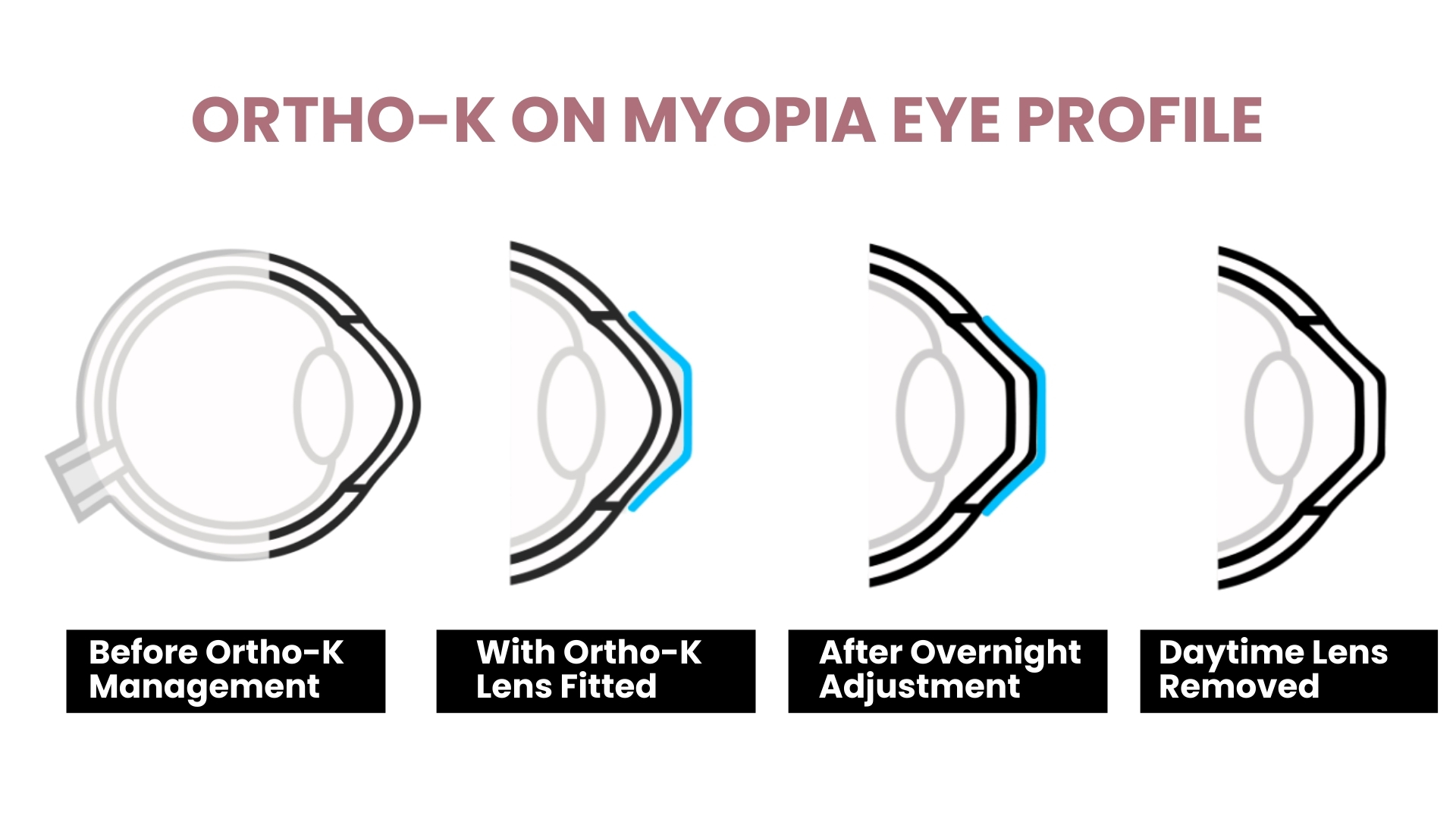
The word temporary means exactly what it sounds like. If your child stops wearing the lenses, the cornea gradually returns to its original curve over several days. Nothing is cut, lasered, or permanently altered on the eye. The cornea is simply held in a new curve by gentle, consistent pressure each night, similar to the way a retainer holds teeth in a new position without changing the tooth itself. That reversibility is part of why many parents feel comfortable trying it. There is no surgery involved at any point in this process, and nothing about the treatment changes the structure of the eye on a permanent basis.
Here is the part that keeps most parents coming back after the first fitting. Ortho-K is one of the recognized approaches our doctors use for myopia management, the term for slowing down worsening nearsightedness in growing children. Nearsightedness, or myopia, happens when the eyeball grows slightly too long, causing distance vision to blur while close objects stay clear. As a child’s eye keeps growing, the prescription tends to keep getting stronger year after year unless something intervenes.
Our practice fits five different approaches to myopia control, and we always mention MiSight 1 day first because it is the only FDA approved contact lens clinically shown to slow myopia progression in children. The full list our doctors work with includes:
We do not promise a specific percentage of slowing with ortho-K, because every child’s eyes respond differently and progression varies from one family to the next. What we can say is that it gives your child clear daytime vision and a role in a myopia management plan at the same time, without adding an extra daily step to the morning routine. You can read more about all five approaches on our myopia management page.
A lot of parents assume the only way to know if myopia is progressing is to wait for the next glasses prescription to get stronger. We use a more direct measurement called axial length, which is the actual physical length of the eyeball from front to back, measured with an instrument called the IOLMaster.
Axial length tends to change before the glasses prescription does. That means we can often tell whether a treatment plan is working months earlier than a parent would find out by waiting for the next eye exam and a new pair of lenses. This measurement is a meaningful differentiator in how we track your child’s progress over time, and it gives parents an objective number to look at rather than a guess based on how well a child happens to read an eye chart on a given day.
Ortho-K is not a one-and-done fitting. It typically involves several visits, spread over a few weeks:
Dr. Massimo Gramanzini oversees the specialty lens fittings at our office, working alongside our team of doctors and certified technicians throughout each stage of the process. You can also learn more about our general exam approach on our eye exam page.
Because these lenses are worn overnight, hygiene matters more than it does with daytime contacts. Our team teaches both your child and you how to clean, handle, insert, and remove the lenses correctly before your child wears them at home unsupervised. That training usually happens in the office over a couple of visits so both parent and child feel confident before the lenses go home.
We also schedule regular follow-up visits to check the health of the cornea and make sure the fit is still right as your child grows and their eyes change shape over time. Skipping those visits is not something we recommend, since routine monitoring is part of what makes overnight lens wear safe for a growing child. If a lens ever feels uncomfortable, is hard to remove, or your child’s eye looks red in the morning, that is a reason to call the office rather than wait for the next scheduled visit.
Most children see clearly through the entire day once their lenses are fully refined. In the early weeks, some kids notice their vision is slightly less sharp by evening while our doctors fine tune the lens fit. This is normal and typically improves with small adjustments over the first several follow-up visits. We would rather tell you this upfront than have it come as a surprise a few weeks into the process, since setting expectations early tends to make the whole experience less stressful for both parent and child.
If your child is tired of glasses, struggles with daytime contacts, and stays active in sports or swimming, ortho-K may be worth discussing at your next visit. Families from Davie, Plantation, Sunrise, Weston, and Cooper City visit our office, right on the Davie and Plantation border with free parking on site, to start this conversation with our doctors.
Call Family Eye Center at (954) 423-8444 or book an appointment online to schedule a consultation and find out if ortho-K is a good fit for your child.
Medically reviewed by Dr. Massimo Gramanzini, OD. Dr. Gramanzini has practiced in Davie for over 25 years and is certified in the treatment and management of ocular disease. Meet Dr. Gramanzini.


