
Medically reviewed by Dr. Massimo Gramanzini, OD
Why do your eyes burn again within an hour of using a drop that is supposed to fix the problem? If your bathroom drawer looks like a small pharmacy and none of it holds, you are not doing anything wrong. You are just treating the wrong layer of the problem.
Most over the counter drops add water to your tear film. That helps for a few minutes if your eyes are simply low on water. But for a large share of chronic dry eye patients we see in Davie, Plantation, Sunrise, Weston, and Cooper City, the problem is not water at all. It is oil.
“Dry eye” is really a catch all term for two different situations.
The oil layer sits on top of your tear film like a lid on a pot. Without it, water evaporates in seconds instead of staying put for minutes. Most chronic dry eye we diagnose traces back to the glands, not the volume of tears you are making. That distinction matters because the two problems are treated differently, and treating the wrong one is why your drops keep failing you.
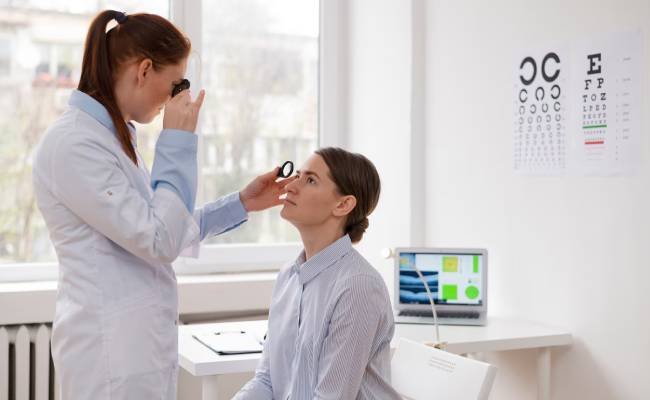
If your oil layer is thin or blocked, adding more water does not fix anything. The new water evaporates at the same speed as your own tears did, because nothing changed about what is supposed to hold it in place. You feel relief for a few minutes because the surface is freshly wet, then you are back where you started. This is the pattern almost every dry eye patient describes to our doctors: temporary comfort, then the burning returns, often worse by the end of a screen heavy workday or after hours in air conditioning.
Burning and a gritty, sandy feeling are the obvious ones. But dry eye also shows up as:
If any of that sounds familiar, the drops are not failing because of bad luck. They are failing because nobody has identified which kind of dry eye you actually have.
This is where a proper dry eye evaluation looks different from grabbing a bottle off a shelf. Our doctors use a handful of specific tests to see what is actually happening on your eye’s surface:
Once we know which type you are dealing with, the treatment plan actually makes sense instead of being another guess.
Nobody needs to jump straight to prescription medication. We build up from the smallest steps and add more only if you need it.
For more severe or stubborn dry eye, especially when the surface of the eye is too irritated for a normal contact lens, scleral lenses are worth asking about. These are larger, rigid lenses that vault over the entire cornea and rest on the white part of the eye, creating a reservoir of sterile saline that stays against your eye all day long. Patients are often surprised that a lens can be the comfortable choice rather than the last resort, but for many people with severe dry eye, that reservoir of fluid does more for comfort than any drop ever could. Dr. Massimo Gramanzini, a member of the Scleral Lens Education Society, fits these using precise measurements from corneal topography, OCT imaging, and TSAS testing, so the lens is built around your eye specifically rather than a standard shape.
Dry eye is a condition we manage, not one we cure with a single visit or a single bottle. For most patients it is a long-term, ongoing part of eye care, similar to how you would manage any chronic condition. The goal our doctors work toward is comfortable, functional eyes day to day, not a permanent fix after one appointment. That means follow-up visits, adjusting the plan as your glands and tear film respond, and being honest with you about what is realistic.
If you are in South Florida and you have given up on finding relief through the pharmacy aisle, a proper evaluation is the next step. Start with a full eye exam so our team can see exactly what is happening on the surface of your eyes before recommending anything.
Call Family Eye Center at (954) 423-8444 or request an appointment online to get a real answer instead of another bottle of drops.
Medically reviewed by Dr. Massimo Gramanzini, OD. Dr. Gramanzini has practiced in Davie for over 25 years and is certified in the treatment and management of ocular disease. Meet Dr. Gramanzini.


